History
The Berlin Wall: why it went up in 1961, why it opened in 1989, and what came after
Listen
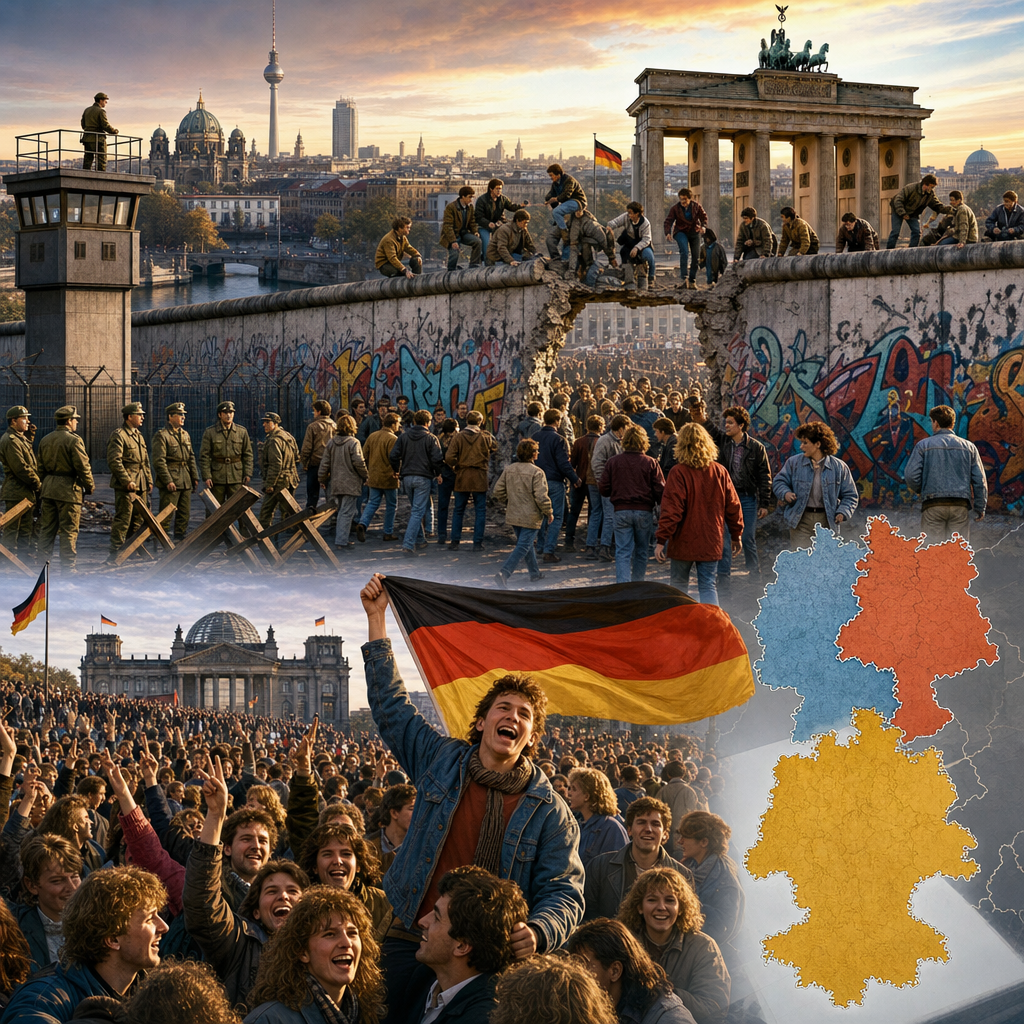
The Wall was built in August 1961 to stop East Germans leaving, and it opened on 9 November 1989 after Hungary's open border, mass protests, Soviet restraint and a muddled announcement. Unification (3 October 1990) and the Soviet collapse (December 1991) are separate events.
What you will learn
- Order four dates on a timeline (13 August 1961, 9 October 1989, 9 November 1989, 3 October 1990) and say what changed on each
- Explain why the Wall opened in 1989 by combining several pressures: emigration through Hungary, mass protest, Soviet restraint, and a muddled press announcement
- Separate the opening of the Wall from German unification in 1990 and from the end of the Soviet Union in 1991, giving a one-sentence reason for each separation
I am Atlas, and today the Wall itself is our evidence.
On 13 August 1961 East German troops and builders sealed the border inside Berlin, first with barbed wire and then with concrete. The reason was people: roughly 2.7 million had left East Germany for the West since 1949, and Berlin was the easiest place to cross. The barrier grew into about 155 kilometres of fortified border around West Berlin, and at least 140 people died at it. Hold that picture: a wall built to keep a state's own citizens in.
STOP AND SKETCH. Draw West Berlin as an island inside East Germany. Mark where a person could once cross freely and where the Wall closed it.
Now the opening. In 1989 several pressures piled up at once. In the spring and summer Hungary began taking down its border fence with Austria, and in September it let East Germans leave through it, so thousands could bypass the Wall altogether. Weekly demonstrations spread from Leipzig, where about 70,000 marched on 9 October. And Mikhail Gorbachev's Soviet Union signalled that it would not send troops to prop up the East German government. Then, on the evening of 9 November, Politburo spokesman Günter Schabowski, handed a new travel rule he had barely read, told a live press conference that it applied 'immediately, without delay'. The plan had been for the next day, with permits. Crowds went to the crossings, the guards were overwhelmed, and the gates opened that night.
Notice the shape of the cause: a government already losing control, plus an administrative slip it could not take back.
Finally, keep three events apart. The Wall opened in November 1989. East Germany held its first free election on 18 March 1990, the 'Two Plus Four' talks settled the wartime powers' rights, and Germany formally unified on 3 October 1990. The Soviet Union itself dissolved in December 1991, a different story with a different cause.
YOUR TURN: do the activity below, then use your timeline to answer the quiz.
Key words
- Berlin Wall
- The fortified barrier that divided Berlin from August 1961 to November 1989, built by East Germany chiefly to stop its citizens leaving for the West.
- Monday demonstrations
- Weekly protests in Leipzig and other East German cities in autumn 1989 that showed the government could no longer rely on fear.
- Schabowski press conference
- The live broadcast of 9 November 1989 in which a muddled announcement about new travel rules sent crowds to the border crossings.
- Two Plus Four Treaty
- The September 1990 agreement between the two German states and the four wartime Allies that cleared the way for unification on 3 October 1990.
Check yourself
Think about it
The announcement of 9 November was an accident, but the government could not undo it. How much of the Wall's fall do you think was chance and how much was already coming? Name two pressures from the lesson as your evidence.