Physics
Ohm's law for one component: I = V/R, ohmic and non-ohmic devices
Listen
For an ohmic component V = IR with constant R, giving a straight I–V line through the origin with gradient 1/R. Wire resistance grows with length. A lamp's rising filament temperature and a diode's one-way conduction make them non-ohmic, so their V/I is not constant.
What you will learn
- Use V = IR to find current, voltage or resistance for a single resistor
- Read an I–V graph: a straight line through the origin means a constant resistance, and its gradient is 1/R
- Identify a non-ohmic device, such as a filament lamp or a diode, from its curved I–V graph
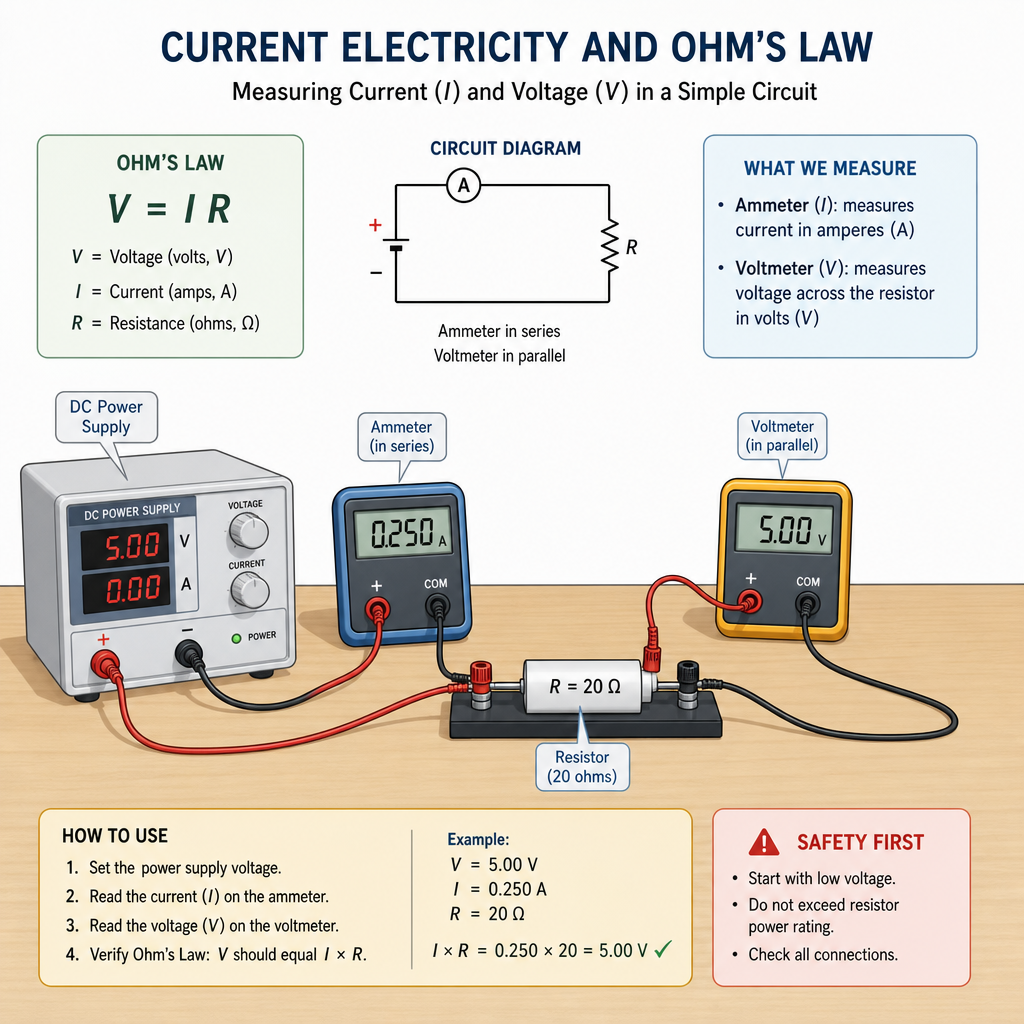
Ohm's law links the voltage across a component, the current through it and its resistance: V = IR. Voltage is in volts (V), current in amperes (A) and resistance in ohms (Ω).
OHMIC DEVICES. A device is ohmic if its resistance stays constant when the voltage changes (at a fixed temperature). Its I–V graph is a straight line through the origin, and the gradient is I/V = 1/R. A steeper line means a smaller resistance. For example, a 50 Ω resistor passes 0.10 A when 5.0 V is across it, and 0.20 A at 10 V.
WHAT SETS R. For a uniform wire, R = ρL/A, so the resistance doubles if the length doubles, and halves if the cross-section doubles. The resistivity ρ depends on the material and its temperature.
NON-OHMIC DEVICES. A filament lamp heats up as more current passes, and its resistance rises, so its I–V graph curves and flattens. A diode passes almost no current for small forward voltages, then conducts strongly above about 0.6 to 0.7 V in silicon, and passes almost none in reverse. For these devices V/I is not constant, and the value of V/I at a given point is the resistance at that voltage.
A TEST OF OHM'S LAW. If you measure V and I for several voltages and V/I stays constant within measurement error, the device obeys Ohm's law.
SAFETY. This lesson is on paper. Real circuits in class use low-voltage cells or supplies of at most 12 V under teacher supervision. Wires and lamps can become hot, and a short circuit across a battery can overheat it. Mains circuits are never opened or tested by students, and batteries are never tasted or punctured.
Key words
- resistance (R)
- The ratio V/I for a component, in ohms; it measures how strongly the component opposes current.
- ohmic conductor
- A conductor whose resistance is constant, so I is proportional to V and the I–V graph is a straight line through the origin.
- non-ohmic device
- A component, such as a filament lamp or diode, whose V/I changes with voltage or temperature.
- resistivity (ρ)
- A property of a material, with R = ρL/A for a wire of length L and cross-sectional area A.
Check yourself
Think about it
Why might a manufacturer quote a lamp's resistance at its working temperature, and what would a cold-resistance measurement with a multimeter be expected to give compared with the working value?