Astronomy
The cosmic web: clusters, filaments, voids
Listen
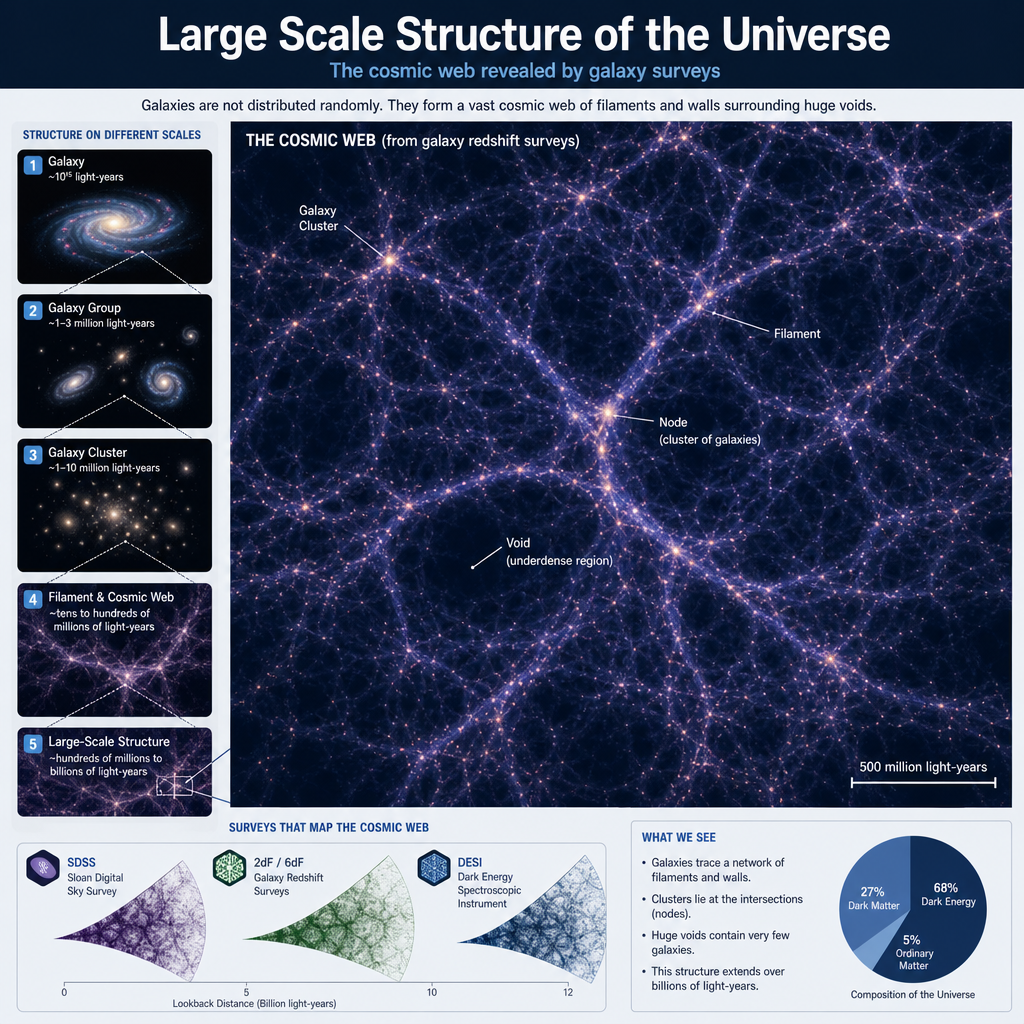
The cosmic web: galaxy clusters, filaments, and voids. Never look at the Sun.
What you will learn
- Name clusters, filaments, and voids as the large-scale web
- Describe voids as huge underdense regions that fill most of the universe's volume
- Explain why you must never look at the Sun or point a telescope or binoculars at it
Atlas here. On scales of hundreds of millions of light-years, galaxies are not sprinkled evenly. Gravity has drawn them into a cosmic web: dense clusters, connecting filaments, and vast underdense voids. Surveys such as SDSS map that web. Here we look at that large-scale pattern rather than at the shape of any single galaxy.
Never look at the Sun, and never point a telescope or binoculars at it. This lesson uses pictures and published data. For any real night-sky viewing, go with a trusted adult and stay off rooftops.
Key words
- filament
- A long, dense ridge of galaxies connecting clusters in the cosmic web.
- void
- A huge underdense region with few galaxies.
Check yourself
Think about it
How does the existence of the cosmic web support the idea that structure in the universe grew from small quantum fluctuations in the early universe?